Skip to main content Skip to search Skip to category navigation Skip to footer

Downwind Foilboards

A downwind foilboard should accelerate quickly, lift off early and give you enough stability while paddling. This is where the shapes differ significantly: a long SUP downwind board for paddle-up starts has different requirements from a

Read more
Skip to sorting and filters

Discover our range

50 Items

Buy a downwind foilboard: how to find the right board

A downwind foilboard should accelerate quickly, lift off early and give you enough stability while paddling. This is where the shapes differ significantly: a long SUP downwind board for paddle-up starts has different requirements from a compact midlength board for light-wind wing foiling or parawing. This buying guide shows you which length, width and volume suit your weight, skill level and intended use.

F-ONE SUP downwind foilboard next to a rider for size comparison

Which downwind foilboard suits your intended use?

For your first paddle-up and SUP downwind starts, choose a long, stable board with 25 to 40 litres more volume than your body weight in kilograms. If you mainly want to wing foil in light wind or start with a parawing, choose a more compact midlength or crossover with volume around your body weight up to 20 litres above it. If you already ride downwind confidently, you can reduce the reserve to 10 to 25 litres for more speed.

UseSuitable board classBuying recommendation
SUP downwind and paddle-upSUP downwind boardBody weight plus 25 to 40 litres
Light-wind wing foilingMidlengthBody weight up to plus 20 litres
Parawing and Foil AssistCrossover boardBody weight up to plus 20 litres
Rider paddling a KT downwind foilboard seen from above

What size downwind board do you need?

Volume is not the only important factor in a downwind foilboard. Two boards with the same volume can feel completely different because of their length, width, rails and volume distribution. Consider rider weight, balance, paddling experience, local conditions and launch method together when choosing.

Volume as a starting point

  • First paddle-up and SUP downwind attempts: As a rule, allow for clearly positive volume. Body weight plus 25 to 40 litres gives many beginners a more useful reserve than a tightly sized performance board.
  • Advanced downwind foilers: Depending on your balance, local conditions and board width, body weight plus around 10 to 25 litres may be enough. Less volume does not automatically make a board faster if it prevents you from applying clean power while paddling.
  • Light-wind wing foiling and midlength: Confident wing foilers can start at roughly their body weight in litres. If you still want to stand, kneel or restart after a touchdown in light wind, a reserve of around 10 to 20 litres is the more practical choice.

Example for a 75 kg rider: Around 100 to 115 litres makes sense for your first paddle-up starts, or 85 to 100 litres if you already have solid downwind experience. For light-wind wing foiling, a midlength of around 75 to 95 litres usually fits, depending on your ability.

Surfpirates tip: Do not choose the narrowest board that can theoretically support your weight when you are learning. A slightly wider, more stable shape often gets you onto the foil earlier because you can apply more paddle power with control.

Why the shape still matters

Volume is the simplest starting point, but it does not determine the ride on its own. A longer shape accelerates more easily, a wider board is more stable and a narrower board glides more efficiently. When comparing boards with similar volume, decide whether you need more stability for learning or more efficiency for fast starts.

What makes a good downwind shape?

  • Long, narrow outline: It creates little water resistance and helps you reach take-off speed with a few powerful paddle strokes.
  • Controlled volume distribution: Volume around the standing area improves stability. Poor distribution can make a board feel tippy despite a high litre figure.
  • Efficient bottom shape: A displacement nose, planing surfaces, steps or a clean-release tail are designed to improve acceleration and water release. Concepts vary between manufacturers.
  • Raised nose and suitable tail: They help during brief touchdowns and prevent the board from sticking unnecessarily when pumping.
  • Stiff foil mount: A solid connection between board and foil provides direct control. Also look for enough adjustment range so you can position the mast to suit the front wing and your stance.
  • Low weight: A light board responds more directly on the foil. For everyday use, durability, carrying comfort and a sensibly positioned handle also matter.

Inflatable downwind foilboards are easier to transport and store. A hardboard usually delivers more direct power transfer and more precise shape control. If travel-friendly dimensions and a small packed size are decisive, an inflatable model can make sense; for maximum performance, a stiff hardboard remains the first choice.

Match the foil and paddle to the downwind board

The board alone does not determine an early start. For your first paddle-up attempts, a front wing that builds lift predictably at low speed while offering enough glide to connect small bumps will help. A very small high-speed wing can make paddling up unnecessarily difficult. An extremely large, high-drag front wing may lift early but can limit speed and control on longer runs.

Clear recommendation for getting started: With comparable mid- to high-aspect designs, around 1,100 to 1,400 cm² is a sensible starting point up to about 70 kg; around 1,300 to 1,600 cm² for 70 to 85 kg; and around 1,500 to 1,900 cm² above 85 kg. Once you can link bumps confidently, you can go smaller for more speed.

The right area depends heavily on profile, span, aspect ratio, rider weight and local conditions. Compare area figures only within similar wing designs. Stabiliser and mast should follow the manufacturer's approved combinations; for open water you also need enough mast length to keep the foil from repeatedly reaching the surface in short waves.

For the paddle, low weight, a blade you can control well and the correct length matter more than maximum blade area. A blade that is too large drains energy and disrupts cadence. A blade that is too small may not provide enough power during the decisive sprint.

Three clear buying profiles for downwind foilboards

Start by identifying your main use. This quickly shows whether you need a long SUP downwind board, a midlength or a versatile crossover shape.

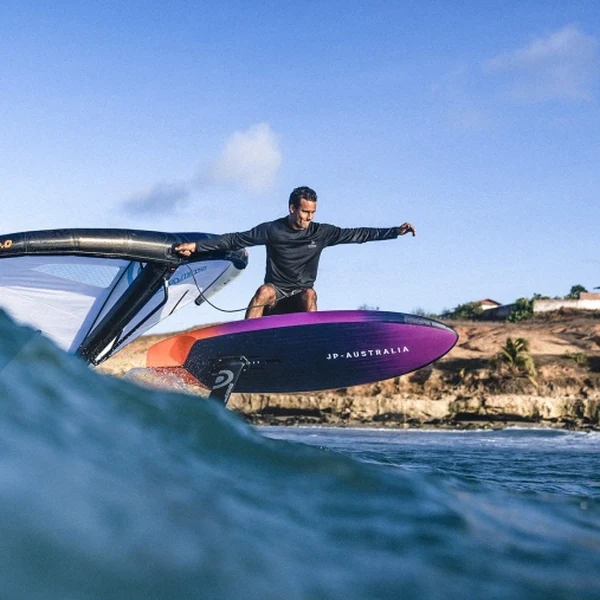
JP Australia midlength foilboard starting with a wing

You are learning to paddle up

Choose a stable SUP downwind board with around 25 to 40 litres of reserve volume. A narrow pro model only makes sense once your balance and paddle-up are reliable.

You want to wing foil in light wind

Buy a midlength or downwind crossover with volume around your body weight up to 20 litres above it. It takes off earlier than a short wing board and remains easier to handle than a pure SUP downwind board. Also check strap options and the standing area.

Compare wing foil sets

You already ride downwind confidently

With reliable paddle-up starts, you can reduce the reserve to around 10 to 25 litres. For short, choppy wind waves, choose a more stable shape than you would for clean ocean swell.

Downwind foilboard pre-purchase check

  • Launch method: Choose between paddle-up, SUP downwind, wing, parawing or Foil Assist.
  • Rider weight: Use it together with experience and balance to determine the necessary volume reserve.
  • Local conditions: Flat water, short wind waves and open swell place different demands on stability and length.
  • Transport: Consider board length, your vehicle, storage space and air travel before buying.
  • Foil compatibility: Check track position, adjustment range, mast, front wing and stabiliser together.
  • Progression: Choose enough stability for your current learning step without losing sight of your intended long-term use.

Tell us your weight, your previous foiling and paddling experience, your local conditions and whether you want to ride SUP downwind, light-wind wing foil or parawing. We will narrow down the length, width, volume and foil with you.

FAQ – choosing the right downwind foilboard

Can I use a downwind foilboard as a normal SUP?

Only to a limited extent. A downwind foilboard is narrow and designed for fast paddling with a foil, not relaxed SUP touring. Buy it for paddle-up and downwind foiling; for tours without a foil, a wider touring SUP is more stable and tracks better.

How much volume should a downwind foilboard have?

For your first paddle-up starts, we recommend body weight plus 25 to 40 litres; for experienced downwind foilers, plus 10 to 25 litres. For a wing foil midlength, confident riders will usually suit body weight up to plus 20 litres.

Should I buy a SUP downwind board or a midlength?

Buy a long SUP downwind board if you want to start with a paddle. For light-wind wing foiling, parawing and better handling in the air, a more compact midlength is usually the better choice.

Can I use a downwind foilboard for wing foiling?

Yes. For regular wing foiling, we recommend a midlength or crossover. A long SUP downwind board takes off very early, but feels larger and less agile in the air.

Hardboard or inflatable downwind foilboard?

Choose a hardboard for the best take-off, direct foil control and performance. An inflatable board is mainly worthwhile when compact packing dimensions, air travel or limited storage space matter more.

Which foil suits a downwind foilboard?

For your first paddle-up starts, we recommend the following for comparable mid- to high-aspect designs:

  • Up to about 70 kg: approximately 1,100 to 1,400 cm².
  • About 70 to 85 kg: approximately 1,300 to 1,600 cm².
  • Over about 85 kg: approximately 1,500 to 1,900 cm².

Experienced riders can choose smaller for more speed. Combine the intended stabiliser with a mast of around 75 to 85 cm; wing areas from different manufacturers cannot be compared directly because profile, span and aspect ratio differ.

Loading ...
Surfpirates Pirates Week from November 20–30, 2026: Extra discounts on many sale items and 15% off RRP, automatically applied at checkout – no discount code needed. Excludes Duotone, Core and Sabfoil. Shop the deals now.