Skip to main content Skip to search Skip to category navigation Skip to footer

Kite Control Bars

Replacing your old kite bar or putting together your first setup? At Surfpirates, you'll find bars for different kites and riding styles. The key is technical compatibility between bar and kite, with trim and quick release within easy

Read more
Buy kite bars – find the right bar for your...
Skip to sorting and filters

Discover our range

42 Items

Buy kite bars – find the right bar for your kite

Replacing your old kite bar or putting together your first setup? At Surfpirates, you'll find bars for different kites and riding styles. The key is technical compatibility between bar and kite, with trim and quick release within easy reach. Here's what matters when choosing a high Y or low V, bar width and line length.

Kitesurfer riding on the water with a kite bar

Which kite bar fits your kite?

A bar from the same brand is a good starting point, but it won't automatically work with every model and year. Combinations across brands can work too. What matters is the front-line split, line tuning, connections and safety system. When choosing a replacement bar, we therefore start with your exact kite model.

Most current inflatable kites use four lines: two outer steering lines and two inner front lines. Some models, such as the Duotone Vegas, need a fifth line. A four-line bar cannot be used for these without the appropriate system.

High Y or low V: what does your kite need?

With a low V, the two front lines separate directly above the bar. With a high Y or V, the split sits further up. This geometry affects the kite's shape and flying behaviour, making it one of the key criteria when buying a bar.

The North Navigator uses a low V in its standard configuration. The Duotone Click Bar 2027 is set to a high split for compatible Duotone kites; for the CORE kites designed for it, you use the high setting on the Sensor 4S. As well as high or low, the exact height of the split matters.

An unsuitable split can change steering, depower and water relaunch. A bar set to a high split is therefore not an equivalent alternative for a kite designed for a low V.

The Duotone Click Bar 2027 and CORE Sensor 4S Pro offer high and low settings. That makes them interesting options for different kites, but line tuning and safety still need to match. For an open, low V on the Click Bar, the V-distributor is removed as described in the instructions.

Choosing bar width and line length

A wide bar gives you more leverage: at the same tilt angle, it creates a greater difference between the two steering lines. This often helps you turn large kites. A narrow bar makes small, fast kites easier to steer smoothly. Many bars have adjustable width so you can use them with several kite sizes.

The table offers a rough guide to bar width, not a recommendation for kite size in a particular wind strength. The ranges deliberately overlap: with a 10-m² kite, a narrower setting can make steering inputs gentler, while a wider setting gives a stronger input. Stay within the intended adjustment range of your compatible bar.

Which bar width suits your kite?
Approx. bar widthApprox. kite sizeUse and handling
38–45 cm4–7 m²Small kites, strong wind, wave riding and foiling. A narrow bar calms fast kites and helps avoid oversteering.
45–50 cm7–12 m²All-round use for freeride, wave and Big Air with medium-sized kites. Many adjustable bars cover this range.
50–55 cm9–15 m²Standard range for many kites of this size. More steering input without choosing an unnecessarily wide bar.
55–60 cm≥ 15 m²Large kites, light-wind setups and foil kites. More leverage helps turn large kites more promptly.

Which line length makes sense?

For freeride and your first setup, around 22–24 metres is a common all-round range. With shorter lines, the kite travels a shorter distance through the wind window. This can give a more direct feel and is used for wave riding and foiling, among other disciplines. Longer lines give the kite more distance over which to build power, which can help in light wind. However, line length does not automatically change the kite's own speed or guarantee more lift or higher jumps.

Line extensions let you adjust the total length. A 22-metre line set with 2-metre extensions, for example, can be flown at 22 or 24 metres. Use extensions that match your line set; line tuning must remain correct and the safety line must be able to run through freely.

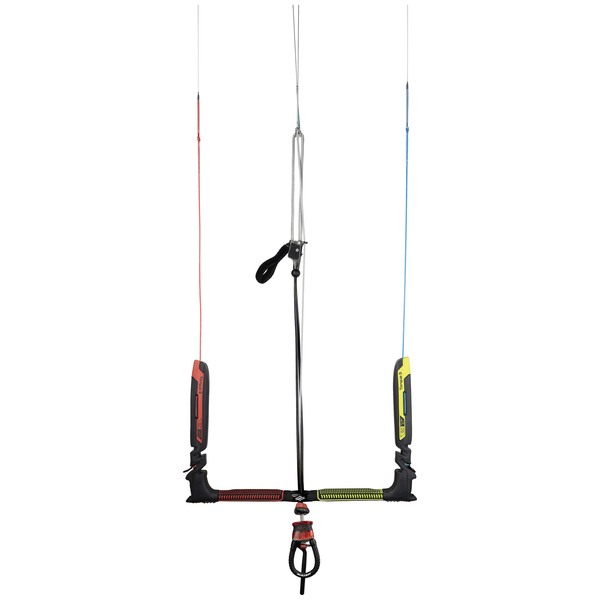
Naish kite bar with steering lines, trim and quick release

Trim, quick release and what's included

The trim adjusts the kite's baseline power. On many bars, the trim handle sits above the bar; on the Click Bar, you adjust it at the bar end. Choose a bar with trim and quick release that you can reach comfortably. Adding more trim does not make an oversized kite suitable for strong wind.

In an emergency, the quick release opens the normal connection to your harness; the kite initially stays connected through the safety leash. Many current systems let it flag out on one front line. The right safety system is therefore a buying criterion, not just the number of lines.

A CORE Pace must not be flown with a Sensor 3S or an older Sensor bar: its fixed bridle requires the designated SFS+ system of the Sensor 4 generation. The Sensor 4S, however, is also compatible with older CORE models such as the XR4 through XR8. New or old alone does not determine suitability.

When comparing prices, check what's included: are lines, loop and safety leash supplied? The loop connects the bar to your harness. Choose its design according to your riding style and harness connection.

Freeride: small and hooked in

For freeride and hooked-in jumps, we recommend a small loop for a fixed harness hook. With a comparable design, this keeps the bar closer to your body.

Freestyle: room to unhook and hook back in

For unhooked tricks, a larger loop makes it easier to unhook and hook back into a fixed harness hook. The loop, hook and leash must be suitable for this use.

Wave: freedom of movement on a rope slider

For wave riding with a rope slider, you need a suitable rope loop or connector. It slides sideways along the rope, giving you more freedom of movement as you turn. A standard loop is not automatically designed to withstand friction on the rope.


Keep your bar, replace parts or buy a new kite bar?

You can keep using a compatible bar that's in good condition. For replaceable wear parts, the right spare for your model and year can be worthwhile. Badly frayed lines, cracks or a sticking quick release need checking before your next session, and damaged parts must be replaced. If suitable spares are unavailable or the safety system doesn't match your new kite, a new bar may be the answer.

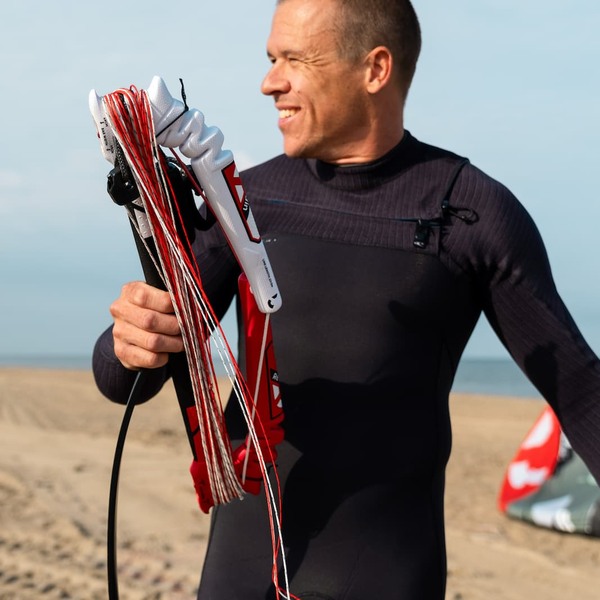
Kitesurfer with a wound-up kite bar on the beach

Find the right bar – including sale models

Compare more than the price: what are the bar width and line length? Are the loop and leash included? Are suitable spare parts available? A discounted model from an earlier season can also be a good fit.

For your first kite, we recommend a matching bar with easily accessible trim and quick release. For a replacement bar, start with your kite's model and year. If you're building a whole quiver at the same time, our kitesurf guide covers sizing and putting together your kite, board and accessories.

Frequently asked questions about kite bars

Can I use one bar for several kites?

Yes, if all the kites match the bar's front-line split, line tuning, connections and safety system. Adjustable bar width also helps you control different kite sizes. When switching between brands, simply swapping the pigtails is therefore not enough.

Can I use my old kite bar with a new kite?

Yes, if it's in good condition and technically compatible. Age alone is no reason to replace it. The front-line split, line tuning, connections and safety must match. The exception of the CORE Pace with a Sensor 3S or older Sensor bar shows why the exact model combination matters.

Are different pigtails enough to make my bar fit my kite?

Different pigtails only address the connection between knots and loops. On bars designed for this, you can swap the short connectors without changing their correct length. The front-line split, line tuning and safety must still match the kite independently of this. New pigtails won't make an unsuitable safety system compatible.

How do I know if my bar needs its line trim adjusted?

If the kite constantly pulls to one side while you hold the bar straight, unequal line lengths may be the cause. Have the line tuning checked before buying a new bar for this reason. If the components are intact, correcting the line trim may be enough; damaged lines must be replaced.

What should I check on a used kite bar?

With a used bar, look for intact lines, a secure grip covering and a quick release that opens and locks reliably. Badly roughened fibres, deep chafing, cracks or corrosion call for inspection before use. Factor any necessary spare parts into the purchase price and check that they're still available for the model and year.

Can I fly a low-V kite with a high-V bar?

Not in an unsuitable high setting: the split can change the kite's shape and therefore its steering, depower and water relaunch. A bar that can be switched to a low V may work if line tuning, connections and safety are also compatible.

Which bar width suits a 9- or 12-m² kite?

Both sizes fall within overlapping ranges in our guide table: 45–50 cm for around 7–12 m² and 50–55 cm for around 9–15 m². A narrower setting makes steering inputs gentler, while a wider setting creates a stronger input at the same tilt angle. What matters is the width intended for the particular kite-and-bar combination; the table is not approval for every combination.

Are 22- or 24-metre lines better for beginners?

Both lengths are within the usual all-round range. Start with the matched standard length of your kite-and-bar set. Compared with 22 metres, 24 metres gives the kite more distance to build power, while 22 metres shortens that distance. Changing line length doesn't replace choosing a different kite size when the wind is too strong or too light for your setup.

Loading ...
Surfpirates Pirates Week from November 20–30, 2026: Extra discounts on many sale items and 15% off RRP, automatically applied at checkout – no discount code needed. Excludes Duotone, Core and Sabfoil. Shop the deals now.