Guide
Windsurf Sail Guide
The engine that drives you on the water. No matter if you are looking for a calm killer or a storm sail, the offer is often confusing. Here is a short introduction to help you find the right sail.
Introduction
Windsurf sails come in extremely different variations and different sizes, between 2.7sqm-12sqm.
Here is a little orientation. Because especially as a beginner we want to help you find the right sail.
Terms

- Loose Leach
- Folds that should form in the upper sail area at the trailing edge of the sail during setup.
- Camber
- Braces rotating around the mast, primarily used in large and propulsion-oriented sails.
- Sail Batten
- Fiberglass or carbon rods that run across the sail and help stabilize the profile.
- Boom
- Boom length, the measurement to which you need to adjust your boom.
- Luff
- The luff length is the length of the leading edge of the sail. Your mast length added to the adjusted length of the extension together give the luff length.
Sail types
- Entry level sail
- Children sail
- Wave sail
- Freestyle
- Freeride No Cam
- Foil sail
Beginner Sail

The sail of your first surf course at the surf school of your confidence usually has only 1-3 sail battens and is mainly made of Dacron, a cloth-like material.
These sails are very stable, but also less powerful and rather heavy. At higher wind or sailing speeds, these sails quickly reach their limits.

Advantages of Dacron sails are low price and good durability. The main sizes used are between 2.0sqm and 5.0sqm.
Children Sail
There are analogous to the Dacron sails also children's sails in this design, which are simply a little smaller, 1.0 - 2.5sqm.
However, there are also "real" foil sails from about 2.0-5.0 sqm. When your kids make their first gliding attempts, the moment has come to switch from the less controllable Dacron sail to the foil sail.

Wave Sail

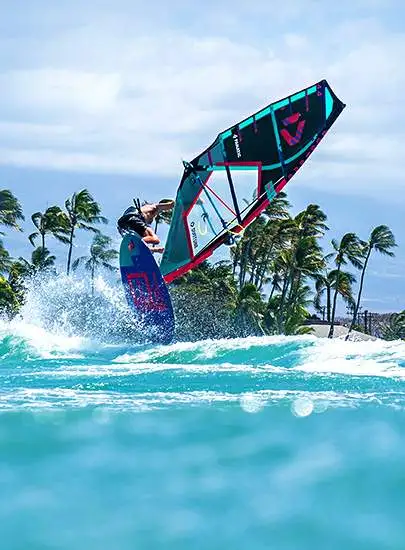
After the first course, the choice of the first own sail often comes up. If you don't want to use sails larger than 4.5 square meters at the beginning, you can't avoid a wave sail, since wave-oriented sails are almost exclusively produced in the small sizes. The size range for wave sails is from approx. 3.0-5.8sqm.
In general, it can be said that wave sails are built either as rather propulsive so-called power wave sails or as very neutral handling-oriented for good wave riding conditions. The propulsion-oriented sails usually have 5 battens, while the neutral 4 or extreme representatives of the group also have only 3 battens.

If you are not sure about your choice of wave sails, the following information can help you.
If you like jumping a lot and focus on that rather than pure wave riding, you are very well equipped with a propulsive sail. Heavier riders also benefit from the extra thrust.
The more propulsive representatives are also very well suited as strong wind flat water sails. Is the focus more on wave riding or do you weigh <75, you should rather take a look at the neutral representatives. Both groups also have a solid suitability for occasional freestyling.
Freeride No Cam
Freeride sails without camber are the most common sail shape. They should be powerful and comfortable at the same time. The main sail sizes are between 5.0-8.5sqm. Compared to models with camber, the sails are lighter overall. Maneuvers like waterstart and power jibes require less power and riding skill than with camber sails. The freeride sail is your companion in an extremely wide range of conditions and requirements.
Both in 3-4 wind forces in the largest sizes in flat water, up to 30-40 kn and challenging choppy conditions, for 80% of recreational surfers it offers the ideal sail choice for all conditions. Oldschool freestyle maneuvers, jumps, as well as carving maneuvers of all kinds will find the right engine here.
Freerace and slalom with camber

This group of sails has 2-4 camber and a very deep propulsive profile. 5.0-9.0 sqm are the most common sail sizes. The handling is both physically and technically more demanding than that of freeride sails without camber. The focus is clearly on the best possible propulsion, acceleration and top speed.
If you have already mastered power jibes and your main interest is to become the fastest on every spot or if you are even aiming at a regatta career, then there is no way around this sailing group.
Foil Sail
In recent years, windfoiling is developing into more and more specialized fields. In the beginning, mainly normal freeride sails were used for foiling, which still works quite well, but many manufacturers now offer pure foil sails.
The specialists can be divided into 2 categories, foil handling sails and performance oriented foil sails. The handling sails have rather short boom lengths and partly 1-2 camber, are very lightly built and the right choice if you want to get as relaxed as possible early on the foil and enjoy carving maneuvers. The performance-oriented sails always have camber and focus on high speeds with a solid handling and large wind range. In combination with such a sail, you resort to potent, fast foils and pursue the goal of being the fastest.

Advice from water sports people
Ask the people who go out themselves
Which size suits your weight and your spot? Bernd, Daniel, Fridtjof and Alex are out on the water themselves and put your setup together with you, by phone, by email or in the shop in Flensburg.
-
 Bernd
Wing foiling & windsurfing
-
 Daniel
Wing foiling & windsurfing
-
 Fridtjof
Kitesurfing & wing foiling
-
 Alex
Kitesurfing